How to shave Maximum Demand: read the load before you pick a method
A battery only cuts your demand charge if it discharges into the exact peak that sets the bill. Which control method does that depends entirely on how your load behaves — so the first step is not sizing hardware, it is reading the load. This is the method EWISER uses, laid out so you can apply the logic yourself, whatever hardware you end up buying.
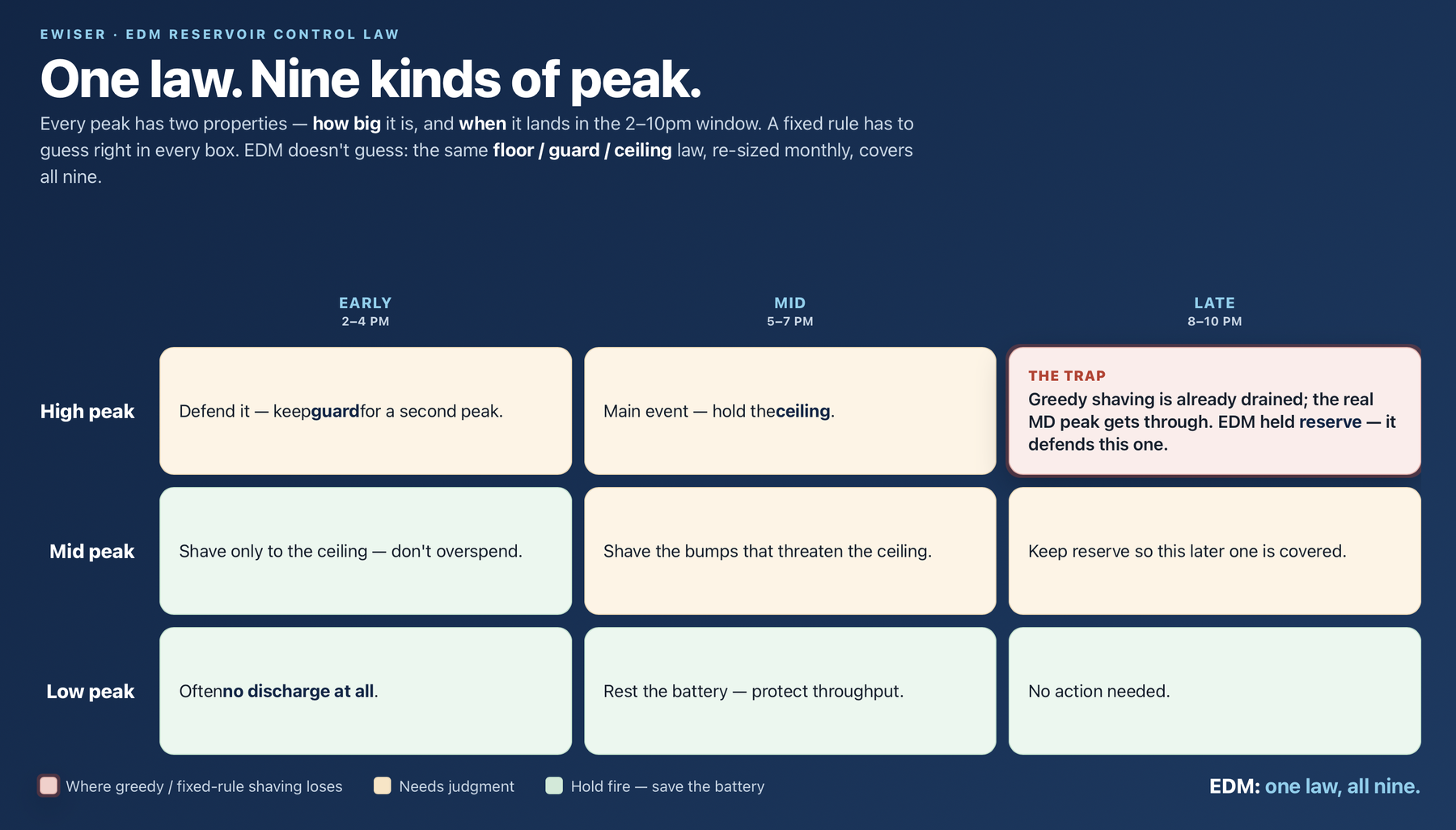
EWISER's EDM applies one adaptive law — floor, guard, ceiling — re-sized monthly, so it holds reserve for the peak that actually sets the bill, whatever its size or timing. A fixed rule has to guess right in every box.
The bill
What you actually pay for: Maximum Demand
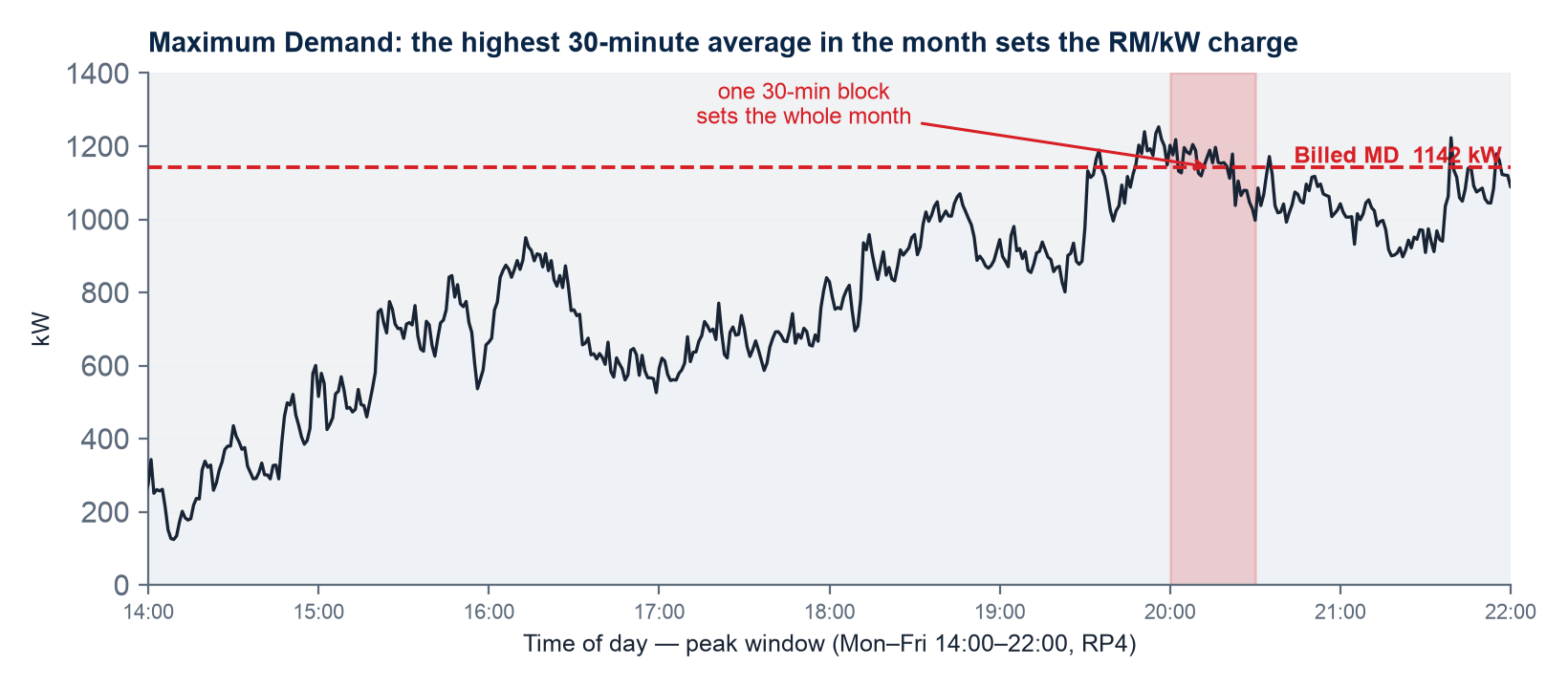
In most commercial and industrial tariffs the demand charge is set by a single number each month: the highest 30-minute average power you draw during the billing window. Malaysia's TNB calls it Maximum Demand (MD); other markets bill the same idea under different names and windows. Because one half-hour decides the whole month's charge, a battery's job is narrow and clear — keep that one worst half-hour as low as possible.
Everything that follows is about hitting that half-hour reliably, month after month. The hard part is that the worst half-hour is not in the same place every day, or at the same height every month — so a battery that is simply 'big enough' is not the same as a battery that actually lowers the billed peak.
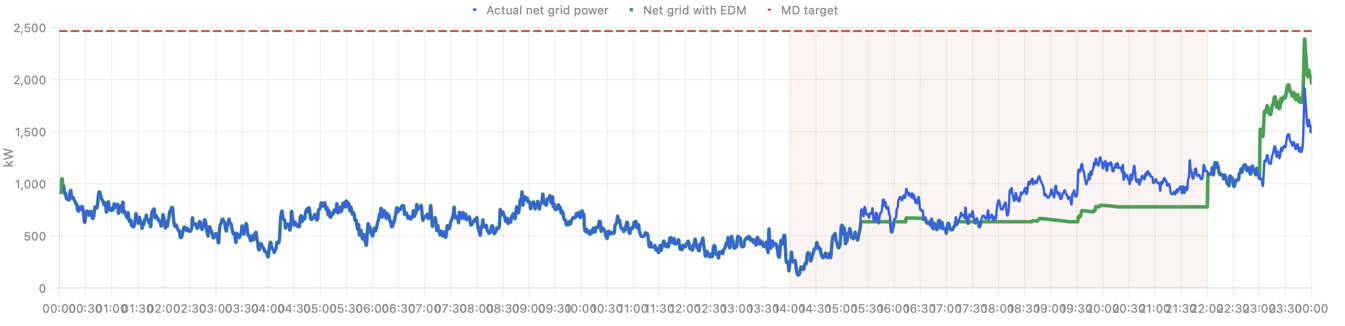
The demand charge is set by the single highest 30-minute average in the month — one half-hour (shaded) sets the whole bill. Peak window Mon–Fri 14:00–22:00.
★ Key takeaway — One 30-minute block sets the whole month's charge. Lower that single half-hour and you lower the bill.
Step 1 · Read the load
Read the load in two dimensions
Before choosing how to shave, look at how the site's peaks behave — in two directions, because each one rules a different method in or out.
Within a month — where do the daily peaks land? Take each weekday's peak and sort it into a simple 3×3 grid: the horizontal axis is the time of day the peak occurs (early, mid or late in the window), the vertical axis is its size (low, mid or high). If almost every peak falls in one cell, the load is predictable and a single setting can catch it. If the peaks scatter across many cells — no single hour and no single size dominates — the load is hard to pin with one fixed rule.
Across the months — does the monthly MD stay level, or jump around? Some sites hold a steady peak; others swing widely as production, shifts and seasons change. If the billed MD moves a lot from month to month, any single fixed target will be wrong in most months: set too high it shaves nothing, set too low it promises more than the battery can hold.
★ Key takeaway — Two readings — scatter within the month, swing across months — decide which method can actually work on your site.
Step 2 · The options
Three ways to shave a peak
There are three ways a battery can cut the peak, and they differ in how they choose the moment and the depth of discharge. The trap in the middle row below is the one that quietly loses money.
Method
How it works
Strength
Weakness
Constant power
A flat discharge across the whole window.
Always lowers MD by a set amount — it never misses the peak.
Blunt: spreads the battery thinly, wastes energy in the valleys, and the cut only shrinks as the battery ages.
Fixed threshold
Commit to one target kW in advance; discharge whenever demand crosses it.
Direct — aims at the peak, not the valleys.
You must guess before you see the load. A wrong guess shaves 0 kW, and the right number changes every month.
Dynamic — EDM
A month-ahead strategy from the site's own history, adjusted in real time through the peak hours.
Adapts day to day and month to month; guarantees a cut and captures the extra upside.
Needs a real control algorithm and live metering — which is what EWISER runs.
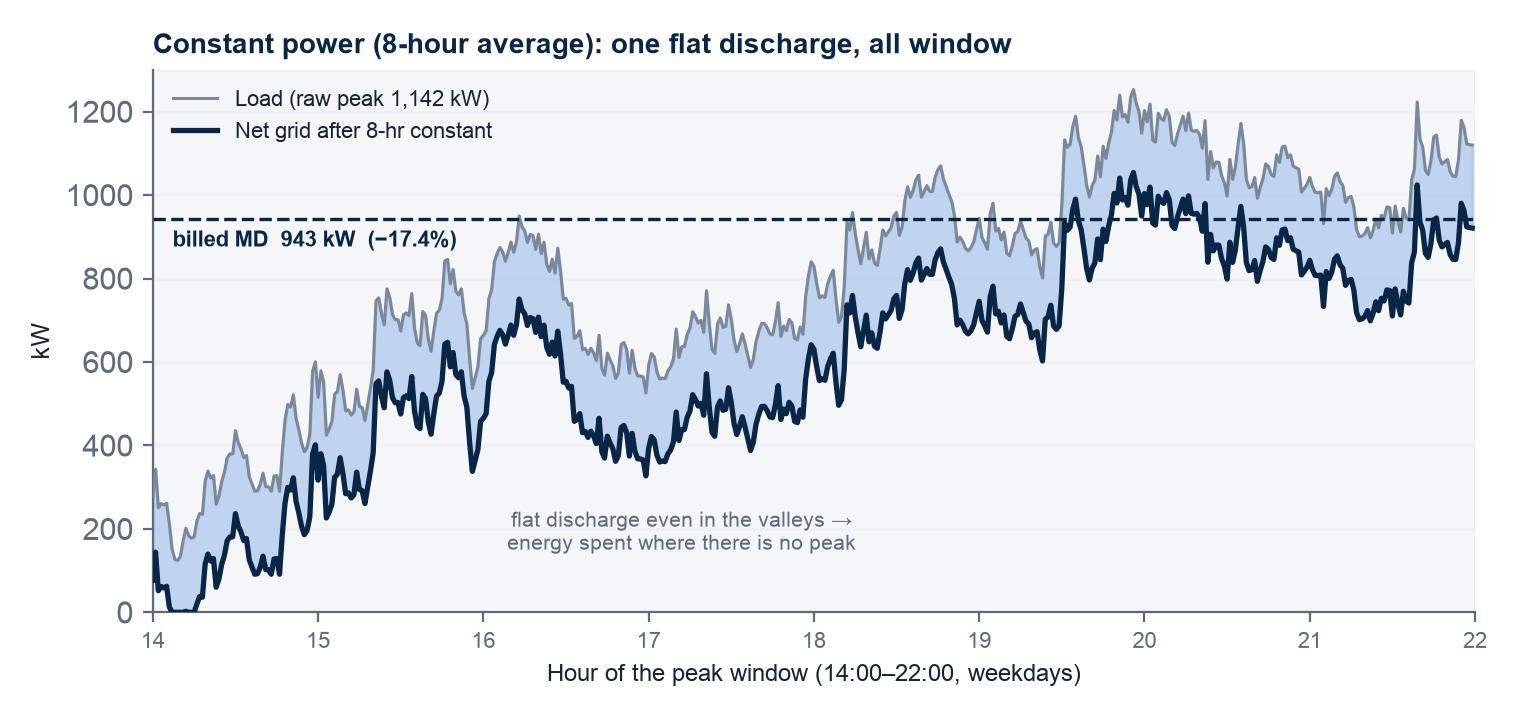
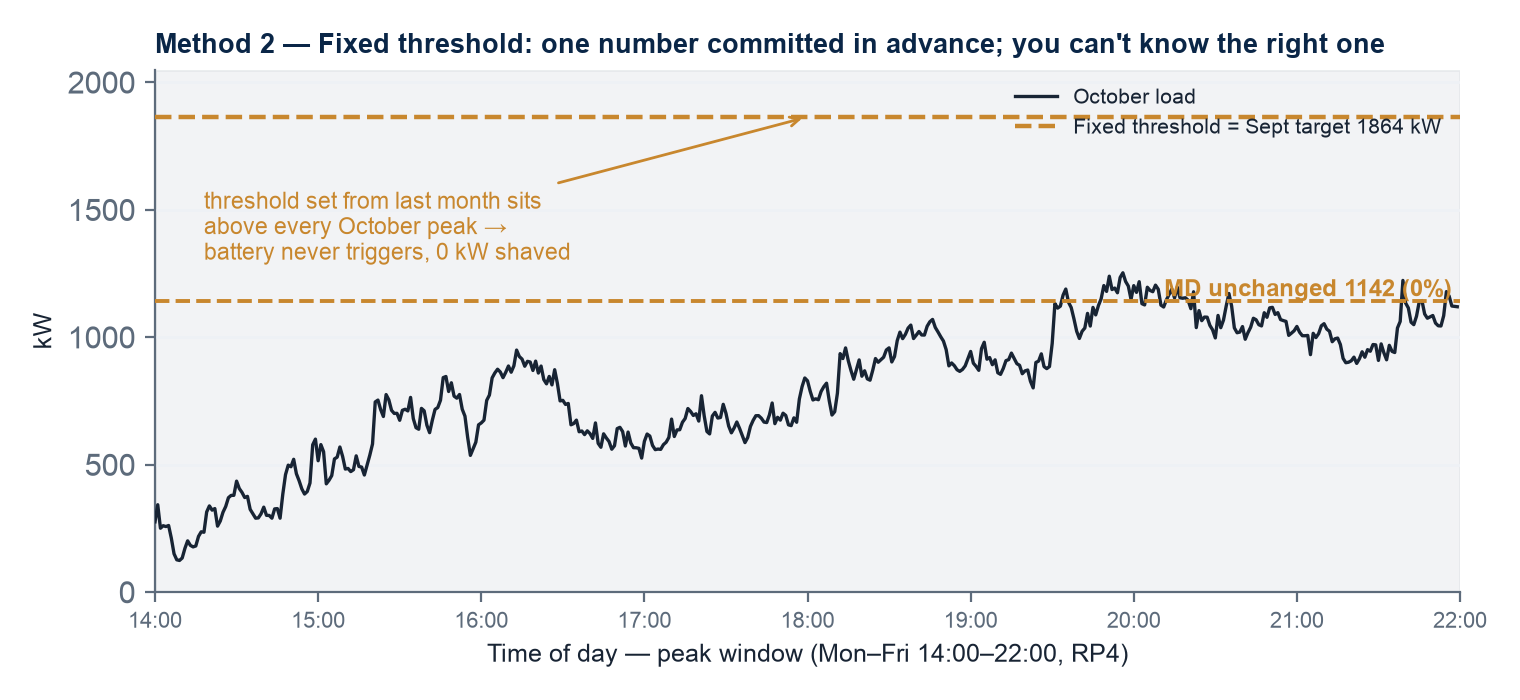
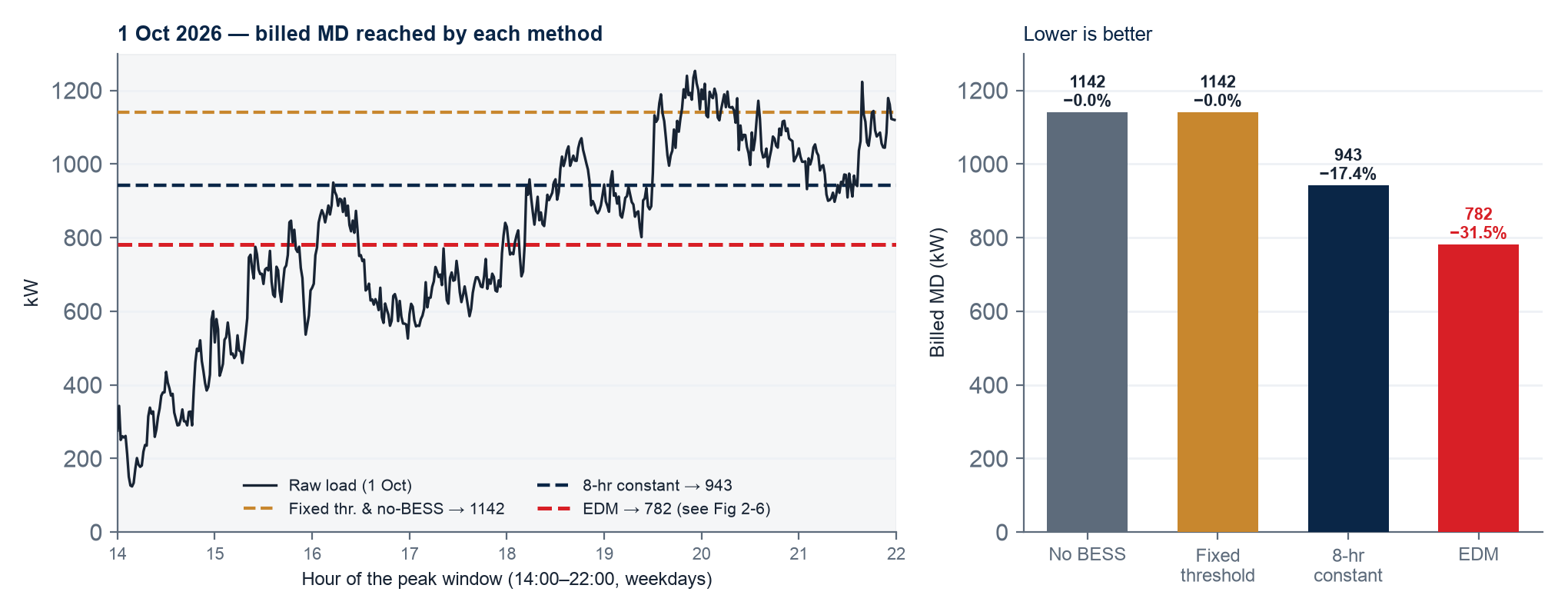
Method 1 — Constant power: one flat discharge across the whole window. It banks a safe cut (here −17.4%) but spends energy in the valleys, where there is no peak to shave.Method 2 — Fixed threshold: a target carried over from last month sits above every peak this month, so the battery never triggers and shaves 0 kW. You cannot know the right number in advance.Method 3 — Dynamic threshold (EDM): a month-ahead strategy adjusted every few minutes. It holds a reserve through the window and defends the real peak when it arrives (here −31.5%).
★ Key takeaway — A fixed threshold set from last month can shave nothing this month — the number you need is not knowable in advance. Only the adaptive method defends the real peak.
Step 3 · Decide
Match the method to how the load moves
Now the two readings pay off: the method you need depends on how much the load moves. Find your row.
MD varies month to month?
Daily peaks scatter?
Method that fits
No
No
Fixed threshold, set once (rare in practice)
Yes
No
Monthly re-targeting
No
Yes
Daily adaptation
Yes
Yes
Adaptive on both — EDM
★ Key takeaway — Choose the method from the load, not from a brochure — and you can only do that once you have read the load.
The trade-off
Safe vs high-yield
There is also a trade-off between safe and high-yield. Constant power is the safe choice, but it banks one low number — and that number only falls as the cells age and capacity fades. A dynamic threshold always delivers at least what constant power would, and usually considerably more; how much more depends on the month's load shape. 'Safe' and 'most savings' are not the same setting, and it is worth knowing which one a proposal is actually quoting before you sign.
Same battery, same day: a fixed threshold can shave nothing, constant power banks a safe cut, and the adaptive method shaves the most. The method is the whole difference.
★ Key takeaway — The adaptive method always delivers at least what constant power would — usually much more.
Takeaway
Make the method earn its number
So before you accept a size or a saving from any vendor, ask two things. First, did anyone actually read this site's load — the scatter of its peaks and the swing of its monthly MD — or was the battery sized to an average? Second, which control method is assumed behind the quoted saving, and does it match how this load behaves?
A saving produced by a fixed threshold on a swinging load is a saving that may never appear on your bill. The honest way to settle it is to test the methods on your own metered load and prove the result before any capital is committed — which is exactly what a free diagnosis, and then Live Shadow on your live meter, are for. EWISER does not sell the battery; it reads the load, picks the method on the evidence, and proves the number against your real bill.
★ Key takeaway — Did anyone read this site's load, and does the assumed method match it? If not, the saving may never reach your bill.
Frequently asked questions
Can't I just set one threshold and leave it?
Only if your monthly Maximum Demand is steady and your daily peaks cluster at one time and size. If the MD swings month to month, a single fixed threshold is wrong in most months — too high and it shaves nothing, too low and it over-promises. Read the load first to find out which case you are in.
What data do I need to tell which method fits?
Interval load data (15- or 30-minute) over a representative period. From it you can sort the daily peaks by time and size, and chart the billed MD month to month — the two readings that decide the method. A free diagnosis does this for you.
Does a bigger battery remove the need for a smart method?
No. A bigger battery raises the ceiling on what you could shave, but a poorly chosen method still leaves most of it on the table — or misses the peak entirely. Method and size are separate decisions; get the method right first.
Is this specific to Malaysia's TNB tariff?
The example term is Maximum Demand (MD), used by TNB in Malaysia, but the logic applies wherever a demand charge is billed on the highest interval of a period — including Singapore and Australia's network demand tariffs. The method is the same; only the tariff names and windows change.