Should your site install a battery? A 5-step decision playbook
You’ve been approached about a battery — or you’re starting to wonder if you should be. This is a plain-English way to make the call yourself, before you commit capital: decide whether it pays, understand your own load, choose a solution on evidence, audit the quotes you receive, and read the return honestly. EWISER does not sell the battery; this is the method we use, laid out so you can run it on your own site.
Step 1 · Decide
Does a battery actually pay on your site?
Start before the sales call: a battery earns its keep where demand (capacity or maximum-demand) charges are a real slice of your bill and your load is peaky — short spikes above a lower baseline. On a flat load with small demand charges, the same battery earns little. The honest first question is not 'which battery', it is 'does my bill even have the shape a battery can cut'.
A battery likely pays if…
Hold off / check first if…
Demand / maximum-demand charges are a big share of your bill
Your bill is almost all energy, with little demand charge
Your load is peaky — short spikes over a lower baseline
Your load is flat and steady through the day
You’re on a demand or time-of-use tariff
You’re on a simple flat tariff with no demand component
Incentives are available (e.g. NSW PRC, GITA)
No incentives, and battery prices are high in your market
★ Key takeaway — A battery pays when a few peaks drive your bill — not just because everyone is buying one. Start from your tariff, not the sales pitch.
Step 2 · Diagnose
Read your own load before anyone sizes anything
In most commercial tariffs, one 30-minute peak each month sets the whole demand charge. So before a vendor sizes anything, look at how your load behaves. Within the month: do your daily peaks cluster at one time and size, or scatter? Across months: does your peak hold steady, or swing? A load that scatters and swings cannot be handled by a single fixed setting — and that decides which solution can actually work. You need interval (15- or 30-minute) load data to see this; it costs nothing to look.
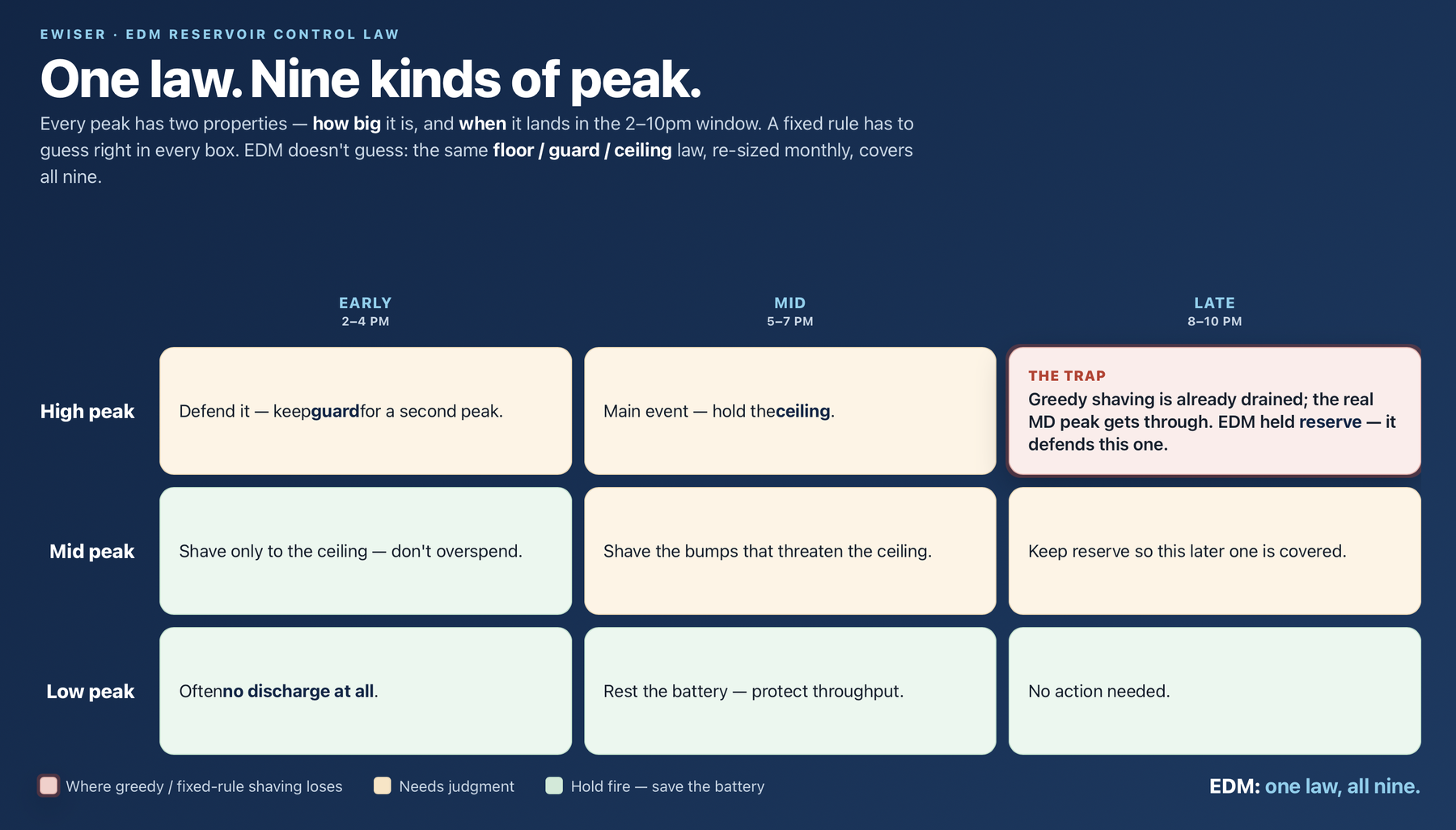
Your bill is set by the single highest half-hour. Sort your daily peaks by time and size: if they fill the grid rather than one cell, no fixed rule catches them — you need a method that adapts.
★ Key takeaway — Your bill is set by a single half-hour each month. Know where your peaks land and whether they swing — a free diagnosis reads this from your own load data.
Step 3 · Size
Size on your load, not on a brochure
Sizing is two numbers that have to fit your load: the usable energy (kWh after depth of discharge, reserve and losses — not the nameplate on the rack) and the continuous power (kW) that can actually cut your peak. Just as important is the control method: a fixed threshold works only if your load is steady and clustered; a scattered, swinging load needs a method that re-finds its target and adapts. Match the method to the load you read in Step 2.
Control method
Fits when…
Watch out for…
Constant power
You want a simple, safe cut
Blunt; wastes energy in the valleys; shrinks as the battery ages
Fixed threshold
Your MD is steady and peaks cluster
Guessing the number; set it wrong and it shaves nothing
Adaptive (e.g. EWISER EDM)
Your peaks scatter and MD swings
Needs a real control algorithm + live metering
★ Key takeaway — Choose the method and the size from your load. A battery ‘big enough’ on paper can still miss the half-hour that sets your bill.
Step 4 · Audit
Audit the quotes you receive
When quotes arrive, don’t compare headline prices — challenge each quote against your own load. The gap between a good-looking slide and what a system delivers on site is where investors lose money. Run this checklist on every proposal.
Ask about…
Why it matters
Usable vs nameplate kWh
You can be 15–25% short once you discount to usable energy
Continuous power (kW) vs your peak
Energy alone won’t cut a tall, brief peak
End-of-warranty capacity (≈70% floor)
A payback on day-one capacity overstates the return
Derating & round-trip efficiency
Net energy at your site ≠ the datasheet gross
Response time vs the billing interval
Slow control logs the peak before it reacts
The control method & tariff assumed
A favourable method on an optimistic tariff is a choice, not a result
Who sized it vs who profits
An independent check is the cheapest insurance
★ Key takeaway — The party that sizes the system often profits from selling it. An independent audit against your own load is cheap insurance on a six- or seven-figure decision.
Step 5 · Verify
Read the return — then prove it on your meter
Finally, read the money honestly. Payback, ROI and net benefit all rest on assumptions — discount rate, price escalation, and whether the saving uses degraded or day-one capacity. Challenge those. And remember the last gap: a projection is not a saving until it reconciles to your actual bill. The strongest de-risking you can do is to prove the saving on your real meter before any capital is committed.
★ Key takeaway — On a real, anonymised case, a Live Shadow projection reconciled to within 0.02% of the billed Maximum Demand — before any hardware went in. Prove before you buy.
The point
Who carries the risk if the numbers are wrong?
You do. The capital is yours, so the sizing, the audit and the proof should come from someone with no stake in which battery you buy. That is the whole idea of an independent decision layer: a free diagnosis to read your load, an independent audit of the quotes, an investment-grade report on the return, and Live Shadow to prove it on your real meter — all hardware-agnostic. EWISER does not sell the battery; it helps you choose and prove the right one.
★ Key takeaway — Make the call on evidence from a party that doesn’t profit from the hardware — that is the whole point of an independent layer.
Frequently asked questions
Do I need my load data to do this?
For Steps 2–5, yes — interval load data (15- or 30-minute) is what lets you read your peaks, size on your real load, and test a quote against it. A recent bill gives a rough starting estimate. A free diagnosis works from your load data.
Does EWISER sell batteries?
No. EWISER is independent and hardware-agnostic. It sizes, audits and proves BESS whatever hardware you choose — the value is the independent analysis and the proof on your real meter, not a hardware sale.
What does an independent check cost?
The diagnosis is free. A full investment-grade project (up to 5 reports for your site) unlocks for 10 credits; an independent audit of a vendor’s quote is 15 credits. Building and diagnosing a project is always free.